What's the Difference?
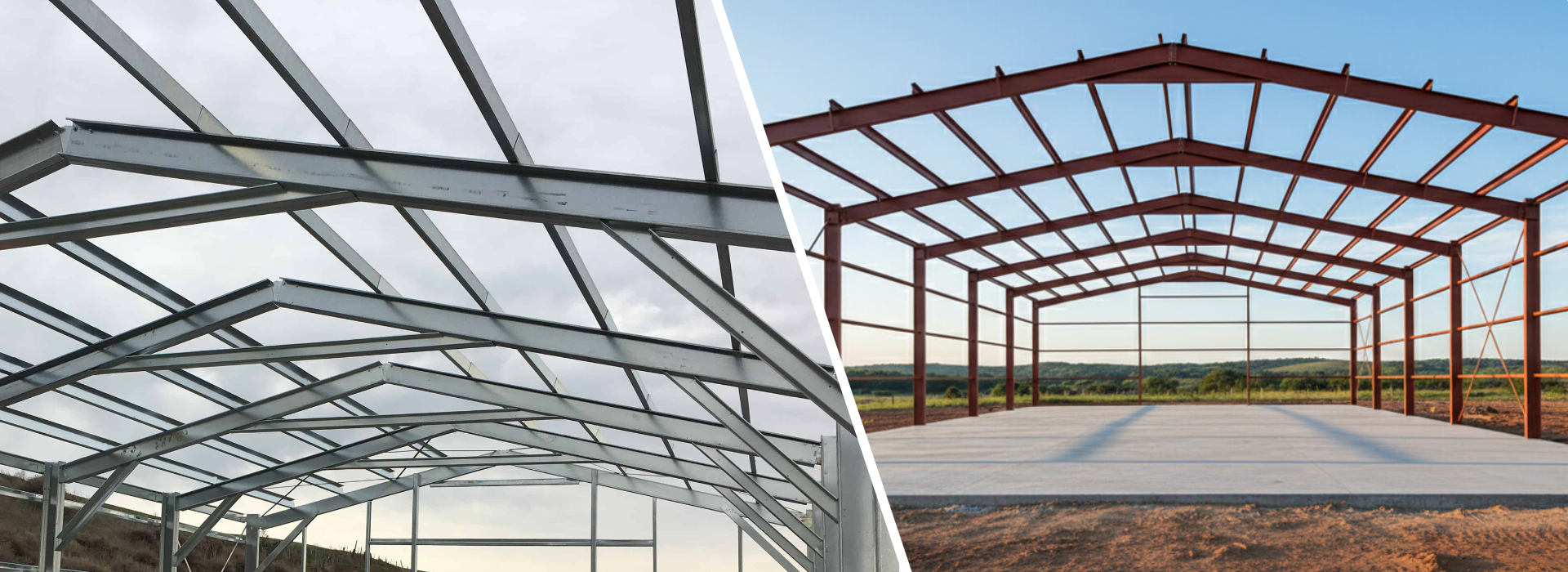
Cold-formed steel buildings are made from roll-formed steel sections — CEE columns, CEE rafters, and ZEE purlins that are cut to length, pre-punched, and bundled into a kit. Every bolt hole is pre-drilled. Every section is labelled. You're assembling a precision kit on site.
Rigid frame (red oxide steel) buildings use heavy hot-rolled I-beam columns and rafters, welded or bolted into moment frames. The same technology you see in large industrial warehouses and aircraft hangars.
The Price Gap Is Real
A rigid frame building for a 40x60x14 footprint typically runs $35,000–$55,000+ for materials alone, depending on supplier, spec, and location. An equivalent cold-formed steel kit from Metroll — engineered for 110 mph winds, code-compliant, with stamped engineering plans and delivery included — comes in well below that range.
The gap between the two systems on a 40x60 can reach $8,000 to $28,000 on the kit alone. That's before you account for the slab and erection differences below.
The Hidden Cost of Rigid Frame
Rigid frame buildings transfer load through moment connections at the column base plates. That means your slab engineer needs to design for uplift and lateral forces — typically resulting in larger isolated footings or a perimeter beam that goes deeper and wider than a cold-formed slab.
A Metroll cold-formed 40x60 uses a straightforward thickened edge slab: 4" slab, 1 foot deep x 1 foot wide thickened edge, with #4 reinforcing bars top and bottom. Columns anchor directly into it with 1/2" x 3" concrete anchors. Your concretor has seen this a hundred times. No special engineering coordination required.
Then there's erection. A rigid frame building needs a crane to lift those heavy welded frames into place — a crane hire day (or two), a rigging crew, and the scheduling that comes with it.
Cold-formed sections are light enough that no crane is required. A small crew can handle erection without craning equipment, which cuts both cost and complexity. Add up the slab premium, crane hire, and the longer labour bill, and the real-world cost gap between cold-formed and rigid frame on a 40x60 pushes considerably higher than the kit price difference alone.
Special Inspections
Rigid frame buildings use high-strength A325 structural bolts at their moment connections. Under IBC Section 1705, A325 bolts require special inspection — a third-party approved inspector must verify installation before work proceeds. That means scheduling, coordinating, and paying for an inspector at each stage of erection.
Rigid frame buildings also involve field welding on site during erection. Any field welding automatically triggers on-site special inspection under IBC 1705.2.1 — no exceptions. If your inspector isn't available when your crew is ready, work stops. These inspections need to be completed and reported to the building official before your permit closes out. In practice, that coordination adds time — sometimes significant time — to your sign-off process.
Cold-formed steel avoids both of these triggers. Metroll's cold-formed buildings use A307 bolts — standard-strength fasteners that are not subject to the high-strength bolt special inspection requirement. There is no field welding. The result is a simpler inspection process, fewer scheduling dependencies, and a faster path to sign-off.
Lead Time: Months vs. Weeks
If you need your building this year, cold-formed has the edge here too. Rigid frame buildings go through a longer custom fabrication and engineering cycle. Industry lead times generally run 12–20 weeks from order to delivery, though this varies by supplier and market conditions.
Metroll's cold-formed buildings are typically delivered within 5-7 weeks. The structural difference between the two systems means cold-formed production moves faster by design.
When Does Rigid Frame Actually Make Sense?
- A clear-span building wider than 100 feet
- A structure carrying overhead cranes or heavy mezzanine loads
- A building with high eave heights and significant snow loads
- A large industrial facility designed for heavy continuous use
Side-by-Side: 40x60x14 Comparison
| Cold-Formed Building | Rigid Frame Building (Red-Iron) | |
|---|---|---|
| Kit price (40x60x14) | $27,000+ | Typically $35,000–$55,000+ |
| Delivery | Included | Often extra |
| Engineering plans | Included | Varies by supplier |
| Slab complexity | Simple thickened edge | Heavier, deeper footings |
| Crane required for erection | No | Yes |
| Lead time | 5-7 Weeks | Typically 12–20 weeks |
| Small crew erection | Yes | No |
| Financing | 0% APR available | Varies by supplier |
| Best for | Up to ~100' clear span, light commercial | Larger clear spans, heavy industrial |
The Bottom Line
Cold-formed steel delivers the same code-compliant result for less money, a simpler slab, no crane, and a faster turnaround. For most workshops, sheds, and light commercial builds at this size, that combination is hard to beat.