B-Deck Interlock vs. Nestable: Which Sidelap Is Right for Your Job?
Spec B-Deck for a roof or floor and you'll hit one question fast: interlocking or nestable sidelap?
Same 1½" profile. Same 36" coverage. Same steel. The only difference is how the edges of adjacent sheets connect — and that one detail changes how the deck installs, how it performs, and what it costs you in labor and freight.
Here's the difference, straight up, and how to pick the right one for your project.
First, the part that doesn't change
Both versions are the same Metroll B-Deck:
- 1½" rib depth, 36" net coverage
- 16, 18, 20, or 22 gauge, Grade 50 steel
- Galvanized G60 or G90, with painted options available
- ICC-ES certified (ESR-5364) — documented capacity your engineer can stamp
- Works as roof deck (warehouses, canopies, industrial facilities) or composite floor deck (mezzanines, multi-story buildings, elevated slabs)
Interlock vs. nestable isn't a different product. It's a different sidelap — the joint where one sheet meets the next.
What is interlocking B-Deck?
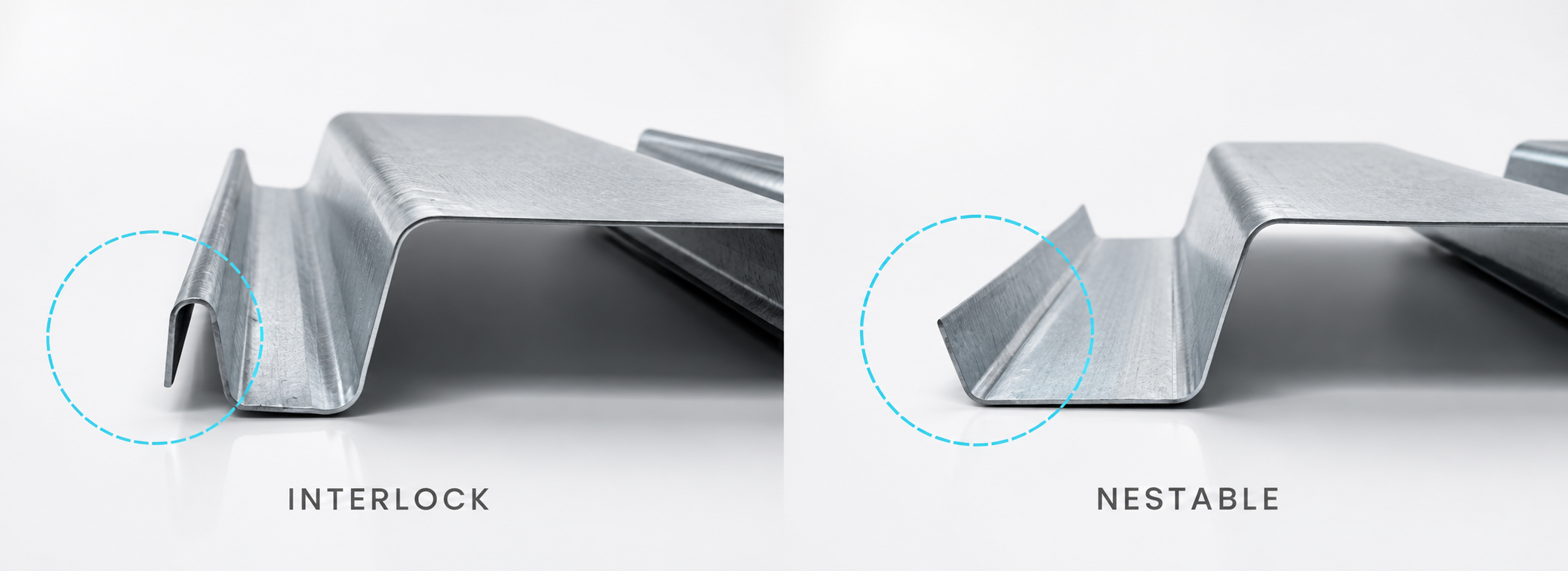
Interlocking B-Deck has edges that fit together like puzzle pieces — a protruding feature on one board seats into a groove on the adjacent board and snaps together.
Why crews like it:
- Faster installation. The snap-together design self-locates each sheet and sets your coverage as you lay it — quicker layout with less measuring.
- A more secure joint. Once locked, panels stay put, which cuts the risk of displacement during install and holds up well in high-stress environments.
- Built for structural demand. The locked sidelap is the reason interlock is the pick when the deck has to work hard.
Where it fits: commercial warehouses, industrial facilities, and any roof or floor where high structural strength and stability are the priority.
What is nestable B-Deck?
Nestable B-Deck skips the locking edge. Its edges are slightly angled so sheets nest inside each other when stacked rather than snapping to a neighbor.
That shape is the whole point. A nested bundle packs tighter, which is designed for easier transport and storage — and it gives the deck more flexibility in how it's used.
Why buyers like it:
- Easier to ship and store. Sheets that nest stack tighter, so bundles take up less room on the truck and less laydown space on site.
- Flexible and versatile. Nestable suits multi-use applications where the deck doesn't need to carry an interlock's structural demand.
- Cost-effective. For lighter-duty work, you get the same B-Deck profile with cost and logistics on your side.
Where it fits: residential buildings and smaller commercial projects where cost savings and flexibility are the priorities.
Side by side
| Interlocking | Nestable | |
|---|---|---|
| Sidelap | Protruding edge snaps into adjacent groove | Slightly angled edges nest together |
| Installation | Snap-together, self-locating, quicker | Flexible, versatile in use |
| Joint performance | Locks tight, resists displacement | Suited to lighter-duty, multi-use loads |
| Stacking & freight | Standard bundles | Nests tight for easier transport & storage |
| Best for | Warehouses, industrial, high-strength structures | Residential, smaller commercial, multi-use |
| Deciding factor | Structural strength & stability | Cost savings & flexibility |