Cold-Formed vs. Tubular Metal Buildings

What's the Difference?

Cold-formed steel buildings are assembled from roll-formed sections — CEE columns, CEE rafters, and ZEE purlins — cut to length, pre-punched, and bundled into an engineered, code-stamped kit.

Tubular buildings are framed from hollow galvanized square tube — the 2¼", 12 or 14 gauge carport-style framing used for roadside carports and prefab garages.


What the Lower Price Leaves Out

  • Site-specific engineering. Many tubular buildings ship without a site-specific load rating; certification to local wind and snow loads is an add-on, and without it a permit may not be possible. Metroll cold-formed buildings are engineered to local loads with stamped plans as standard.
  • Span and load. Tubular spans shorter and carries less. It's sold at wide footprints, but width requires heavier 12-gauge framing and bracing. Cold-formed clear-spans without interior posts.
  • Lifespan. Galvanized tubular lasts around 15–25 years; cold-formed steel framing is commonly rated at 25-30 years.

Strength & Slab

Tubular tube is light and flexible, and an under-specified frame can fail under high wind or heavy snow. Cold-formed sections are often built with a 2-ply web for more strength at the same thickness, and the lighter frame allows a simple thickened-edge slab — a 4" slab with a 1-foot-deep by 1-foot-wide edge, columns anchored directly in. Both systems are galvanized and resist rot, termites, and fire; cold-formed also won't warp, shrink, or split.


When Tubular Makes Sense

  • Open carports and vehicle, RV, or boat covers
  • Small sheds in mild climates where upfront cost is the main factor
  • Non-occupied structures that don't need a permit

Side-by-Side:

Tubular Cold-Formed
Frame Hollow square tube Roll-formed C-sections (often 2-ply web)
Best for Carports, covers, small sheds Enclosed, permitted, code-rated buildings
Typical size ceiling ~30 ft wide, ~500 sq ft Workshops, light commercial, multi-family
Engineered to your site? Usually an add-on Built in from the start
Lifespan ~15–25 years ~25–30 years
Upfront cost Lower Mid — and lower total cost of ownership

The Bottom Line

Tubular is the cheaper choice for carports, covers, and small sheds. For an enclosed, permitted building — especially at 40x60 — cold-formed adds site-specific engineering, longer span, a simpler slab, and a longer service life for a cost difference that's usually small once tubular is specified to the same standard.

Cold-Formed vs. Rigid Frame Steel Buildings

What's the Difference?

Cold-formed steel buildings are made from roll-formed steel sections — CEE columns, CEE rafters, and ZEE purlins that are cut to length, pre-punched, and bundled into a kit. Every bolt hole is pre-drilled. Every section is labelled. You're assembling a precision kit on site.

Rigid frame (red oxide steel) buildings use heavy hot-rolled I-beam columns and rafters, welded or bolted into moment frames. The same technology you see in large industrial warehouses and aircraft hangars.


The Price Gap Is Real

A rigid frame building for a 40x60x14 footprint typically runs $35,000–$55,000+ for materials alone, depending on supplier, spec, and location. An equivalent cold-formed steel kit from Metroll — engineered for 110 mph winds, code-compliant, with stamped engineering plans and delivery included — comes in well below that range.

The gap between the two systems on a 40x60 can reach $8,000 to $28,000 on the kit alone. That's before you account for the slab and erection differences below.


The Hidden Cost of Rigid Frame

Rigid frame buildings transfer load through moment connections at the column base plates. That means your slab engineer needs to design for uplift and lateral forces — typically resulting in larger isolated footings or a perimeter beam that goes deeper and wider than a cold-formed slab.

A Metroll cold-formed 40x60 uses a straightforward thickened edge slab: 4" slab, 1 foot deep x 1 foot wide thickened edge, with #4 reinforcing bars top and bottom. Columns anchor directly into it with 1/2" x 3" concrete anchors. Your concretor has seen this a hundred times. No special engineering coordination required.

Then there's erection. A rigid frame building needs a crane to lift those heavy welded frames into place — a crane hire day (or two), a rigging crew, and the scheduling that comes with it.

Cold-formed sections are light enough that no crane is required. A small crew can handle erection without craning equipment, which cuts both cost and complexity. Add up the slab premium, crane hire, and the longer labour bill, and the real-world cost gap between cold-formed and rigid frame on a 40x60 pushes considerably higher than the kit price difference alone.


Special Inspections

Rigid frame buildings use high-strength A325 structural bolts at their moment connections. Under IBC Section 1705, A325 bolts require special inspection — a third-party approved inspector must verify installation before work proceeds. That means scheduling, coordinating, and paying for an inspector at each stage of erection.

Rigid frame buildings also involve field welding on site during erection. Any field welding automatically triggers on-site special inspection under IBC 1705.2.1 — no exceptions. If your inspector isn't available when your crew is ready, work stops. These inspections need to be completed and reported to the building official before your permit closes out. In practice, that coordination adds time — sometimes significant time — to your sign-off process.

Cold-formed steel avoids both of these triggers. Metroll's cold-formed buildings use A307 bolts — standard-strength fasteners that are not subject to the high-strength bolt special inspection requirement. There is no field welding. The result is a simpler inspection process, fewer scheduling dependencies, and a faster path to sign-off.


Lead Time: Months vs. Weeks

If you need your building this year, cold-formed has the edge here too. Rigid frame buildings go through a longer custom fabrication and engineering cycle. Industry lead times generally run 12–20 weeks from order to delivery, though this varies by supplier and market conditions.

Metroll's cold-formed buildings are typically delivered within 5-7 weeks. The structural difference between the two systems means cold-formed production moves faster by design.


When Does Rigid Frame Actually Make Sense?

  • A clear-span building wider than 100 feet
  • A structure carrying overhead cranes or heavy mezzanine loads
  • A building with high eave heights and significant snow loads
  • A large industrial facility designed for heavy continuous use

Side-by-Side: 40x60x14 Comparison

Cold-Formed Building Rigid Frame Building (Red-Iron)
Kit price (40x60x14) $27,000+ Typically $35,000–$55,000+
Delivery Included Often extra
Engineering plans Included Varies by supplier
Slab complexity Simple thickened edge Heavier, deeper footings
Crane required for erection No Yes
Lead time 5-7 Weeks Typically 12–20 weeks
Small crew erection Yes No
Financing 0% APR available Varies by supplier
Best for Up to ~100' clear span, light commercial Larger clear spans, heavy industrial

The Bottom Line

Cold-formed steel delivers the same code-compliant result for less money, a simpler slab, no crane, and a faster turnaround. For most workshops, sheds, and light commercial builds at this size, that combination is hard to beat.

Metroll's W2 Deck Now ICC Certified

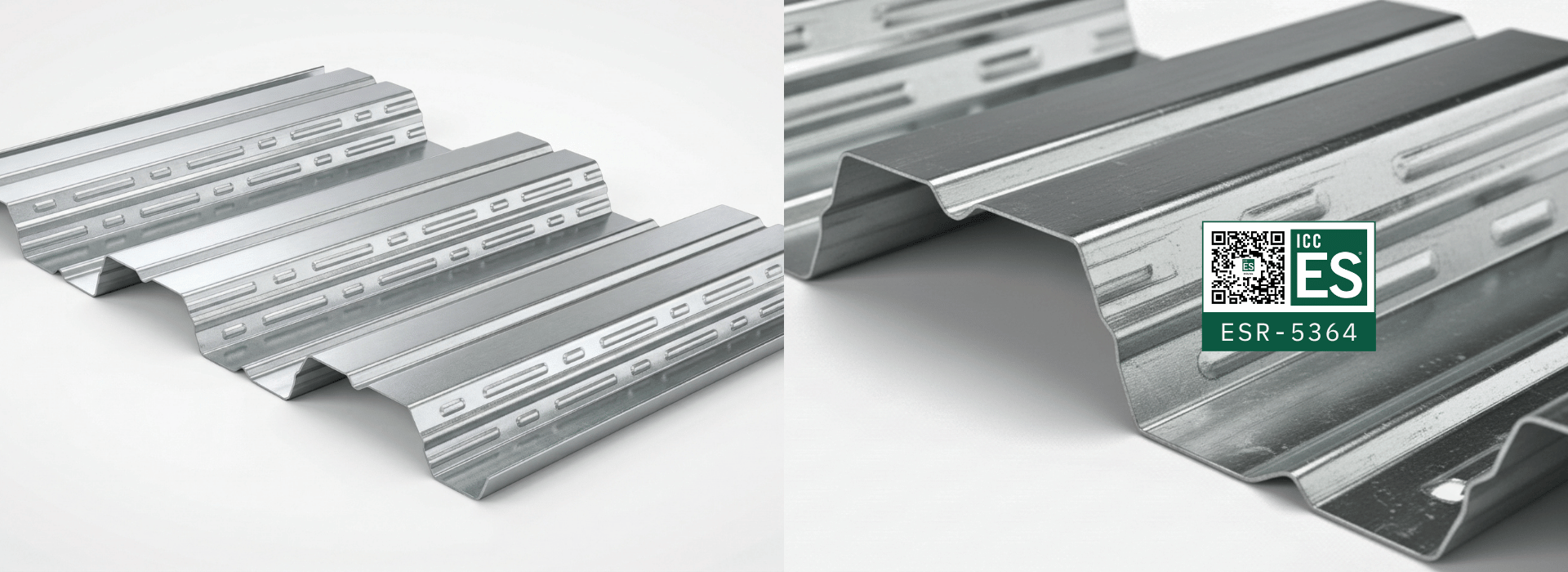
We are proud to announce that Metroll’s W2 Deck has earned ICC certification, a trusted mark that confirms our composite floor deck meets rigorous building code standards. This certification gives contractors, architects, and engineers increased confidence specifying W2 Deck on projects requiring compliance with local and national codes.

Why ICC Certification Matters

ICC (International Code Council) certification means that W2 Deck has undergone thorough evaluation and testing to verify its compliance with key structural and fire safety codes. For projects undergoing plan review and permitting, using an ICC-certified product helps speed approvals and ensures your design meets applicable regulations.

Key Benefits of W2 Deck with ICC Certification

  • Engineered for composite action with cast-in-place concrete slab
  • Available in multiple gauges and vented/non-vented panel options
  • Mechanical embossments for superior concrete bonding
  • Provides consistent performance across a wide range of building types
  • Supports long spans with reduced steel weight compared to alternatives

How This Helps You on the Jobsite

Choosing ICC-certified W2 Deck means less uncertainty during inspections and submittals. Building owners gain peace of mind with a tested and proven floor deck solution, while contractors benefit from reliable lead times and consistent product quality. Metroll stands behind every sheet of W2 Deck with strong warranties and dedicated customer support.

Next Steps

  • View the official ICC Evaluation Report – ESR-5364
  • Download load tables and warranty details from our Resources library.
  • Contact your Metroll sales representative to discuss W2 Deck options for your upcoming project.
  • Review project specifications to confirm how W2 Deck can meet your design and code requirements.

We remain committed to providing durable, engineered steel decking solutions you can trust. The new ICC certification for W2 Deck reinforces our dedication to quality, safety, and your project’s success. For questions or technical assistance, reach out any time.

Building Beauty in the Hills: Adobe Hill Winery’s Story

From Vision to Vineyard

In the testimonial, the Adobe Hill team shares how finding the right material supplier was as important as selecting the perfect grape clones. Their brief was simple: blend rustic charm with modern durability. They wanted a structure that could:

  • stand up to coastal winds and summer heat,

  • echo the cool tones of the surrounding chaparral, and

  • be erected quickly so the family could open doors for the 2025 harvest season.

Metroll’s factory‑direct model—and a reputation for one‑on‑one service—checked every box.

Choosing the Palette: Tahoe Blue & Old Town Gray

After evaluating several finishes, the owners settled on Metroll’s Tahoe Blue PBR panels for both roof and walls, accented with Old Town Gray trims. The color pair mirrors the clear California sky and the slate outcrops along the vineyard road, while the PBR profile’s 36‑inch coverage kept installation time and waste to a minimum.

Key Components Supplied by Metroll

Primary structure

  • Product: Galvanized C- & Z-purlins

  • Reason: Long-span strength; pre-punched accuracy

Roof & wall skin

  • Product: 26GA Tahoe Blue PBR panel

  • Reason: High weather resistance; quick fastening

Architectural accents

  • Product: Old Town Gray trims & flashings

  • Reason: Clean, complementary lines 

A Walk Through the Winery

  • Crush Pad & Production Hall – Wide bay spacing keeps floors free of columns, making forklift traffic smooth during harvest.

  • Barrel Cellar – The insulated PBR walls maintain consistent temperatures, reducing HVAC loads.

  • Terrace Tasting Room – A soaring mono‑slope roof frames sunset views; exposed purlins double as design elements.

Throughout the tour, the owners point to crisp panel laps and tight corner trims—details they say “give the building that finished, handcrafted look our guests expect.”

Built for Generations

Metroll’s SMP coating system offers a 40‑year film‑integrity warranty and strong color‑retention, meaning the signature Tahoe Blue will stay vibrant long after the vines mature. The all‑steel envelope is also fire‑resilient—critical in Southern California’s wild‑land interface.

Thinking About Your Own Steel Project?

Whether you’re crafting a boutique winery, a farm outbuilding, or a commercial space, Metroll’s factory‑direct approach delivers:

  • Speed – Short lead times and pre‑punched accuracy

  • Savings – No middle‑man mark‑ups

  • Support – A dedicated team that treats you like a partner

Ready to turn vision into reality? Contact Metroll Fontana for samples, color chips, or a no‑obligation quote.

Steel strong. California proud. Built with Metroll.

Palm Springs Solar Carport Structure

At Metroll, we thrive on projects that challenge both our scale and our precision. Our recent collaboration with the Palm Springs Surf Club—an exciting desert-oasis destination where indoor wave pools meet outdoor thrills—showcases exactly why industry leaders rely on us for structural steel solutions.

Project Overview

Nestled at 1500 S Gene Autry Trail in Palm Springs, CA, the Surf Club needed more than just shade for its parking lot. They wanted a solar carport that would deliver comfort to guests and clean energy to power resort operations. We answered that call with:

  • 109,213 lbs of G90-galvanized, 12GA Cee-purlin

  • 15,570 ft of precision-punched structural steel (almost twice the length of the Golden Gate Bridge)

  • 2 full truckloads dispatched straight from our Fontana yard

This heavy-gauge backbone forms the canopy for a 250 kW solar array—today shading 112 stalls and covering over 70 % of the Club’s electricity needs.

AI-Punched Precision: Every Hole, Every Time

Manual hole-drilling under the desert sun? Not on our watch. We leveraged our AI-driven punch press to scan, position, and stamp each 12″× 3.5″ Cee-purlin with surgical accuracy. The result:

  • Zero field re-drilling—saving installation hours and labor costs

  • Uniform hole patterns—ensuring seamless rail alignment for solar modules

  • Traceable quality—each piece is logged and certified in our system

This level of automation and data-driven production means our partners install faster, safer, and with absolute confidence.

Logistics & Delivery: Fontana → Palm Springs

Coordinating two truckloads of structural steel is no small feat. Our logistics team choreographed a precise schedule:

  1. Load Out: Forklifts stacked purlin bundles onto trailers at first light.

  2. Route Planning: A mapped route (Fontana → Palm Springs, 160 miles) kept transit time tight.

  3. On-Time Arrival: Deliveries reached the Surf Club site on schedule, ready for installation.

By handling both the manufacturing and the freight, Metroll ensures seamless “one-stop” service for large-scale builds.

Impact & Sustainability

The finished solar canopy delivers more than shade:

  • 112 shaded parking stalls, enhancing guest comfort after every wave session

  • A 250 kW photovoltaic array generating an estimated 400,000 kWh annually

  • Over 70 % offset of the Club’s electricity consumption—dramatically reducing grid dependency

Beyond cost savings, the project underscores met corporate commitment to sustainability and community well-being.

Big Steel. Big Projects. Big Names.

From massive weight and length to AI-punched precision and turnkey delivery, Metroll stands apart in the structural steel arena. Whether you’re planning a solar carport, industrial facility, or architectural marvel, count on us to lead—never simply follow.

Flat vs. Striated Standing Seam Panels

One of the most common decisions customers face is choosing between flat and striated standing seam panels. In this blog, we’ll break down the key differences, explore the impact of oil canning, and help you decide which finish is best suited for your project.

Flat Panels

Flat standing seam panels feature a smooth surface between seams, giving a clean, minimalist look that appeals to architects and modern designers.

Benefits of Flat Panels:

  • Modern Aesthetic: Clean lines and a crisp appearance ideal for contemporary designs.

  • Smooth Texture: Great for exterior walls or facades where texture is not desired.

  • Architectural Appeal: Flat panels often photograph well and are visually striking on commercial or residential builds.

Considerations:

  • Oil Canning Risk: Flat panels are more prone to a cosmetic phenomenon called oil canning, which causes visible waviness in the flat areas due to expansion and contraction of the metal.

  • Extra Precautions Needed: Installers may need to use thicker gauges or backer rods to minimize oil canning effects.

Striated Panels

Striated panels have shallow, continuous indentations (striations) running along the flat part of the panel. These are designed to add strength and reduce visual distortions.

Benefits of Striated Panels:

  • Reduced Oil Canning: The number one reason to choose striations — they help disguise or reduce the appearance of waviness.

  • Added Rigidity: The striations add minor structural strength to the panel without altering its basic look or performance.

  • Balanced Aesthetic: You still get a clean look, but with subtle texture that improves appearance over time.

Considerations:

  • Less Sleek Look: For designers seeking a glass-smooth facade, the texture may not be preferred.

  • Slight Shadowing: Depending on sunlight and roof orientation, striations may cast light shadows visible from certain angles.

When to Choose Which?

Choose Flat Panels if:

  • You prioritize a sleek, uninterrupted surface

  • The roof or wall is not in direct sunlight or highly visible

  • You’re using heavier gauge metal or taking other oil canning precautions

Choose Striated Panels if:

  • You want a more forgiving, uniform finish

  • The panels are wide or in lighter gauges

  • The surface will be visible under changing light conditions

What Is Oil Canning?

Oil canning is a cosmetic issue in metal panels where the flat areas appear wavy or distorted under certain lighting conditions. It’s not a structural defect, but it can affect the appearance of the roof or wall. This effect is more pronounced in flat panels, particularly those with large widths or thinner gauges.

While oil canning doesn’t impact the performance of the panel, it can detract from the visual appearance. Striated panels are one of the most effective ways to minimize this effect.

Simulated Rust vs. Cold-Rolled Steel: Understanding the Differences & Benefits

Steel is a versatile material used across industries, from construction to architectural design. However, the choice between simulated rust and cold-rolled steel can impact a project's durability, aesthetics, and maintenance requirements. In this blog, we’ll explore the key differences between these two materials and when to use each one.

What is Simulated Rust Steel?

Simulated rust steel, also known as pre-weathered or rusted-look steel, is designed to give the appearance of aged, oxidized metal without actual corrosion. This effect is typically achieved through specialized coatings, treatments, or pre-finished steel surfaces that replicate the natural rusting process.

Benefits of Simulated Rust Steel:

  • Aesthetic Appeal: Provides a rustic, aged look without structural deterioration.

  • Low Maintenance: Unlike real rusted steel, it does not require ongoing treatments to prevent excessive corrosion.

  • Durability: Coatings prevent further oxidation, ensuring longevity in various environments.

  • Versatility: Ideal for decorative panels, architectural facades, interior designs, and signage.

What is Cold-Rolled Steel?

Cold-rolled steel is manufactured by rolling steel at room temperature, creating a smoother, more precise finish. It is commonly used in applications where precision, strength, and a refined surface are necessary. Cold-rolled steel is also an option for customers who want a rusted appearance over time, as it naturally rusts when exposed to the elements.

Benefits of Cold-Rolled Steel:

  • Higher Strength: Increased hardness and tensile strength compared to hot-rolled steel.

  • Smooth Surface: Ideal for applications requiring uniformity and a clean finish.

  • Better Precision: Tight dimensional tolerances make it suitable for structural and industrial uses.

  • Improved Fabrication: Works well for forming, bending, and welding in manufacturing.

  • Natural Aging Effect: Over time, cold-rolled steel develops a rusted patina when exposed to moisture and air, creating an organic weathered look.

When to Choose One Over the Other

  • For Decorative and Architectural Uses: Simulated rust steel is the ideal choice when you want the aged aesthetic without worrying about structural degradation.

  • For Structural and Industrial Applications: Cold-rolled steel provides the strength and precision needed for load-bearing projects and fabricated components.

  • For Customers Wanting a Natural Rusted Look: Cold-rolled steel is the better option if you prefer a surface that rusts naturally over time for an organic, evolving appearance.

  • For Cost Considerations: Cold-rolled steel is often the more economical choice for projects requiring bulk steel materials.

  • For Environmental Exposure: Simulated rust is better for decorative use in exposed environments, while cold-rolled steel may require additional treatments to prevent unwanted corrosion.

Fire-Resistant Steel Buildings by Metroll

When fire strikes, you need a building that stands up to the challenge. That’s where Metroll steel buildings shine. Designed with fire safety in mind, our steel structures combine strength, style, and peace of mind. Here’s how we keep your people, property, and investments protected:

Why Steel? Fire Resistance You Can Trust

  • Naturally Noncombustible: Steel is naturally noncombustible and retains its structural integrity even under extreme conditions.

  • Code-Compliant Safety: Our steel structures meet and exceed the rigorous fire-resistance standards of the International Building Code (IBC)

Heat-Resilient Strength

Structural steel retains 60% of its strength even at temperatures as high as 1,000°F, ensuring safety when it matters most. This remarkable resilience provides extra time for evacuation and emergency response, minimizing potential risks. When the heat is on, steel’s strength helps protect what matters most—people and property.

Safety Meets Style

Choose from cost-effective, fire-rated coatings that combine safety with aesthetic appeal. Our coatings not only protect against fire but also resist wear and tear, ensuring your building stays durable and visually stunning for years to come. Whether you prefer a sleek, modern finish or a bold, custom look, we’ve got options to match your style and budget.

Take The Next Step

At Metroll, we believe safety isn’t just a feature—it’s the foundation of every building we create. With our fire-resistant steel buildings, you’re not just investing in a structure. You’re investing in security, reliability, and peace of mind.

Ready to build smart, safe, and strong? Contact Metroll today and let’s make fire safety the cornerstone of your next project!

Why Galvanized Steel is the Ideal Choice for Dairy Facilities

When designing or upgrading a dairy facility, choosing the right steel material is critical — not just for durability, but for long-term hygiene and cost efficiency. While both Galvanized and Galvalume steels are popular in agricultural construction, their performance differs significantly when exposed to livestock environments.

The Environment Inside a Dairy Facility

Dairy barns and milking parlors are naturally humid environments with constant exposure to moisture, cleaning chemicals, and animal waste. Ammonia, uric acid, and other compounds from livestock excrement create a highly corrosive atmosphere that challenges most coatings and finishes.

In these conditions, your steel’s surface treatment can make all the difference between decades of performance and premature rust.

Galvanized vs. Galvalume: The Key Difference

At first glance, Galvanized and Galvalume steel look similar — both are coated to prevent rust and extend service life. But the composition of their coatings is what sets them apart:

  • Galvanized Steel: Coated with 100% zinc.

  • Galvalume Steel: Coated with a mix of aluminum (55%), zinc (43%), and silicon (2%).

This difference affects how each performs in harsh environments like dairy facilities.

Why Galvanized Outperforms Galvalume in Dairy Environments

  1. Better Resistance to Animal Waste Corrosion
    The ammonia and acids present in livestock waste can react with the aluminum in Galvalume coatings, causing accelerated corrosion and rust.
    Galvanized steel, coated purely in zinc, forms a protective barrier that resists these chemical reactions, making it ideal for barns, stalls, and parlors.

  2. Superior Protection Against Constant Moisture
    Dairy facilities are regularly washed down to maintain hygiene. Zinc’s sacrificial protection means even if the surface is scratched, the surrounding zinc continues to protect the steel beneath — something Galvalume cannot do as effectively in wet, acidic environments.

  3. Simpler Maintenance, Longer Life
    With Galvanized steel, maintenance is straightforward. Routine cleaning and ventilation can keep the panels performing for years without special coatings or replacements, reducing downtime and costs.

  4. Proven Track Record in Agriculture
    For decades, galvanized steel has been the trusted standard for agricultural buildings — not just for roofs and walls, but also for feed troughs, pipe rails, and ventilation structures. Its consistent performance in high-moisture, high-ammonia settings makes it the material of choice for dairy operators.

When to Use Galvalume

While Galvalume performs exceptionally in dry, non-corrosive conditions — such as residential roofing or industrial warehouses — it is not recommended where it comes into contact with animal waste, fertilizers, or manure gases. Its aluminum component breaks down under these conditions, leading to early coating failure and corrosion.

Final Takeaway

When building for the dairy industry, longevity and sanitation are non-negotiable. Galvanized steel provides the reliability and protection your facility needs — resisting corrosion, maintaining a clean surface, and ensuring long-term performance even under demanding conditions.

Buy America vs Buy American

Understanding the Difference Between "Buy America" and "Buy American" Steel Requirements

In the construction and manufacturing industries, sourcing materials, particularly steel, often comes with a set of guidelines and regulations. Two commonly referenced policies are the "Buy America" and "Buy American" provisions. While they may sound similar, these regulations differ in their scope and application, especially when it comes to steel. Understanding these differences is crucial for businesses aiming to comply with government contracts and projects. Here’s a breakdown of what sets these two provisions apart.

Buy America Act

The Buy America Act is specific to transportation and infrastructure projects funded by the federal government, such as highways, bridges, railroads, and public transit systems. It mandates that all steel and iron used in these projects must be produced in the United States, from the initial melting stage through to the final manufacturing. The goal is to ensure that federal funds are spent on U.S.-produced materials, supporting the domestic steel industry.

Key Requirements:

  • Domestic Production: The steel used in Buy America projects must be entirely manufactured in the U.S. This includes all steps in the production process, from smelting to the final product.

  • Applicability: Buy America applies specifically to projects funded by the U.S. Department of Transportation (DOT) and its agencies.

  • Waivers: In some cases, waivers can be granted if domestic products are not available in sufficient quantity or quality, or if using them would significantly increase project costs. However, these waivers are becoming increasingly rare as the government pushes for more stringent adherence to Buy America requirements.

Buy American Act

The Buy American Act has a broader scope and applies to all government procurement, not just transportation or infrastructure projects. This law requires that federal government purchases of goods, including steel, must be primarily made from U.S.-made materials. However, the Buy American Act is less stringent than Buy America in several key ways.

Key Requirements:

  • Substantial Transformation: Under the Buy American Act, the steel does not need to be 100% produced in the U.S. It can include foreign components, as long as the final product is "substantially transformed" in the United States, meaning significant manufacturing processes occurred domestically.

  • Applicability: This act applies to all government procurement contracts, including defense and other federal agencies, but it doesn’t extend to state or local projects unless federal funds are involved.

  • Waivers and Exceptions: There are numerous exceptions under the Buy American Act, including when foreign-made products are significantly cheaper, or when U.S. goods are not readily available. Additionally, trade agreements with other countries can allow for foreign products to be treated as if they were U.S.-made.

Differences in Steel Requirements:

  1. Domestic Production vs. Substantial Transformation:

    • Under Buy America, all steel must be entirely made in the U.S., from raw material through the final product. No foreign steel is allowed in the process.

    • Under Buy American, foreign steel can be used, as long as the final product undergoes significant manufacturing in the U.S. This means some components could come from abroad, but the product must be substantially transformed domestically.

  2. Scope of Projects:

    • Buy America applies specifically to infrastructure projects funded by the DOT or its agencies.

    • Buy American covers all federal procurement, meaning it applies to a broader range of projects but with more flexible requirements.

  3. Waivers:

    • Waivers under Buy America are harder to obtain, as the focus is strictly on supporting U.S. steel production.

    • Buy American allows for more waivers and exceptions, making it easier for contractors to use foreign materials if they meet certain criteria, such as cost savings or availability.

Why the Difference Matters

For companies involved in steel manufacturing or supplying, understanding the difference between these two provisions is critical to maintaining compliance with federal contracts. Misinterpreting the rules could result in costly project delays, penalties, or even disqualification from bidding on federal projects. Contractors working on infrastructure projects need to ensure that all their steel meets the strict Buy America requirements, while those involved in other government procurement may find some flexibility under the Buy American Act.

Conclusion

While the terms "Buy America" and "Buy American" might seem interchangeable, their requirements, particularly regarding steel, are distinct. The Buy America Act enforces a stricter, more localized approach to steel production for transportation projects, while the Buy American Act provides more flexibility, allowing for the inclusion of foreign materials as long as they undergo substantial transformation in the U.S. For businesses navigating these regulations, staying informed on the differences ensures smooth project execution and continued compliance with federal standards.

By understanding these nuances, contractors and suppliers can better align their practices with government requirements and maintain a competitive edge in federally funded projects.